Welcome to the 34th issue of my Justice League series, my favorite so far of the four I have completed.
This issue was actually the first issue I started writing, about a year ago, when I was toying with the idea of re-starting this series. I didn't like the one and only JLA-JSA (Justice Society of America) team-up I had done back in the Nineties (issues 21-22, see link on the right to read them if you haven't already). So I knew that I wanted to do another JSA team-up if I committed to doing these comics again.
And I knew I could use that story as a template to start re-writing these, following the pacing and layout standards that I was already familiar with. Story-wise, originally I thought of following just one group of characters to one Earth, but then I couldn't decide which group to spotlight! Then I hit on the idea of doing *both* sides of the story, and it started falling into place....as you will see, and hopefully agree.
There's not a lot I can say before you read the story because I don't want to spoil anything. However, I can say that for the first time in these three issues, the cover gave me a problem. Should I spotlight one of the teams' actual action scenes? If so, which one? Should I do a "poster" type of the JLA and or the JSA? I didn't have a strong notion either way.
I was still in a quandary until November, when the great Nick Cardy passed on. Looking over some of his classic art, including his classic JLA covers, I came across JUSTICE LEAGUE #107. I suddenly saw this image re-imagined for my needs. Let me know what you think. Please note that I used as many of the same characters as I could, only replacing Green Lantern with Wonder Woman. Dr. Fate and Sandman (if you know who they are) simply moved down, not out. :-)
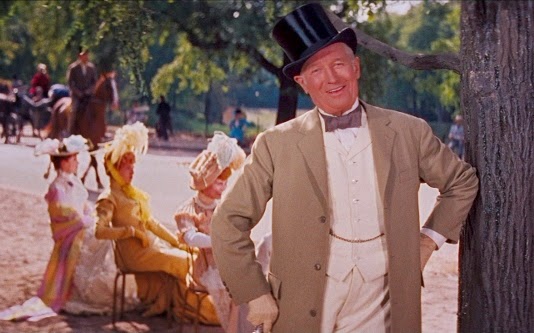
Congratulations to all those David Niven and Cantinflas fans. Two weeks ago I said that Around the World in Eighty Days was the least deserving Best Picture film. I now stand corrected, as Gigi definitely has less going for it than the 1956 Mike Todd produced epic does. Shall I count all the things wrong with this motion picture? Yes, I shall. Be warned: there are huge spoilers if you have never seen this film. This movie I don't recommend you ever seeing, but you might want to, so be fore-warned.
Alan Jay Lerner and Frederick Lowe became famous after they wrote My Fair Lady for Broadway in 1956. As they were enjoying that success, they began to work on a musical adaptation of the short-story Gigi by Colette for MGM. There are similarities between the two works, and in a very real sense "if you've seen one, you've seen them both." Both feature the "teaching" of a younger female character for the pleasure of a man. Both feature strongly misogynist older gentlemen as the leads. Both feature costumes and scenes over characterization. And to my ear, both feature similar music and lyrics.
Gigi is about a young girl who is being raised by her grandmother and great-aunt, as her mother is too busy being an extra in the Parisien opera to raise her herself. Gigi's one friend is a man she considers her older brother, Gaston. Why or how they met is never explained, but he is an incredibly rich eligible bachelor who enjoys stopping by and spending time with Gigi and her grandmother. Gigi goes to her great-aunt twice a week to learn about feminine things such as jewelry, the proper way to eat, or the proper way to pour coffee. All is going along fine until Gaston catches his girl-friend cheating on him; he publicly embarrasses her and then tries to show Society that he is not upset by the break-up by throwing several lavish parties. Unfortunately, he stops by and visits Gigi again, and when he realizes he has more fun with Gigi and her grandmother in one evening than he has all week in Society, on a whim he offers to take both of them with him to the seaside. After this little vacation, her grandmother and great-aunt decide to speed up Gigi's lessons. They have a conversation I simply did not understand: one says to the other, "Did it never occur to you that Gigi...?" the other gasps, and the scene is over.
Well it turns out that in a scene soon after this, Gigi asks her great-aunt point blank, "So I will never get married?" to which the reply is, "We do not plan to marry at first, but it is possible that we may end up married at last." This is when I suddenly realized that the elderly women were training Gigi to be a high-priced call girl! Sure enough, Gaston comes back from his business trip and the grandmother makes him promise to make a "business deal" for Gigi. He has their lawyer call his lawyer. They work the arrangements out, but when Gaston himself calls on Gigi again she flatly refuses him. She does not want to be his mistress. However, the next day she calls him back and says she would rather be miserable with him than without him, so agrees to the arrangement. They go out to the trendy restaurant Maxim's, where Gaston realizes that she is behaving like a trained monkey, and is not the Gigi he fell in love with. So he drags her back home and then, finally, asks her to marry him, presumably to stay away from the shallow Social life he hates.
And this is me trying to be nice in my description of the story! I don't know if this, My Fair Lady, and Camelot (all by Lerner-Lowe) were true representations of their times or not, but to watch them today it's shocking to see just how misogynist they are. I will give you two examples from this film: at the beginning of the film we meet the charming Maurice Chevalier as Gaston's uncle, Honore. He introduces the story and then sings, "Thank Heaven For Little Girls" while lecherously eyeing a prepubescent girl! (You can catch a glimpse of the actual scene I mean in the trailer below). At the time maybe this was "cute," but now I can't think of this character as anything other than as a dirty old man. Likewise, later in the film he consoles Gaston when Gigi has refused to be his concubine. He tells Gaston that if Gigi says no to Gaston's offer to "buy" her, she isn't good enough for him. Let me say that again: he tells Gaston that if Gigi says no to Gaston's offer to "buy" her, she isn't good enough for him. This is a class war and a gender war that I want no part of! By this point I was just waiting for the film to end.
Of course, if I had liked the lead characters or the music by this time I would have been more invested, right? Well I'm here to tell you that the only song you have ever heard of from this movie is Chevalier's "Thank Heaven For Little Girls." Watch the trailer below and tell me that you have ever heard any of these other songs. They are forgettable, partly because they are so similar to the score from My Fair Lady. Only one other song was familiar to me, "I Remember It Well," because my parents would sometimes quote that line back at each other or us kids. The song is a duet between Chevalier and Herminone Gingold (as Gigi's grandmother). However, watching it now I can't tell if it's a fun story about how romance is not as important to men as it is to women, or a creepy story about how men remember conquests but not the details about them. While I was watching it I couldn't tell if Chevalier really did "remember it well" or was just humoring Gingold. Nor could I tell if Gingold knew, either, or cared.
I almost got through the whole review without commenting on either of the two leads: Leslie Caron as Gigi, and Louis Jordan as Gaston. They are fun together, but dull apart. I don't know if it's chemistry, or the plot, but whenever they were apart the film was incredibly dull. In fact, one song that Jordan has with Chevalier is called, "It's a Bore." Yes, it is. Neither of them lit up the screen for me, although I didn't dislike Caron here as I did in An American In Paris. In a film full of unlikeable characters, she and Jordan were able to make their parts slightly warm and loveable. Due to the nature of the plot, however, I never felt like I knew and/or understood either of them. This film is definitely a Best Picture for "production" rather than for acting. Tellingly, none of the actors were even nominated.
Comparing this film to other Best Picture winners, it is almost impossible for me to come up with anything that might have made this Oscar-worthy at all, and yet it won nine awards! Director Oscar for Vincente Minnelli might have been his "career" Oscar, but the music, screenplay, costumes, cinematography...okay, I'll give you those two last ones. The film IS easy on the eyes. But the song "Gigi" is utterly forgettable! Checking on what it was up against that year in Best Song competition, I have to admit I haven't heard of any of the other songs, either. I guess if you like musicals (which I do, in general) and if you like comedies (which I do, and this one really isn't one to my taste) you might like this. Or you might feel cheated, like I did, and hate it. If you have agreed with most of my other opinions, that I would suggest you might not care for this film.
Gigi
*Academy Award Best Picture of 1958*
Produced by Arthur Freed
Directed by Vincente Minnelli
Screenplay by Alan Jay Lerner
Also Nominated:
(in alphabetical order)
Auntie Mame
Cat On A Hot Tin Roof
The Defiant Ones
Separate Tables
My recommendation would be to see any or all of these other nominees before you took the time to watch Gigi. Auntie Mame is a wonderful comedy with Rosalind Russell as the free-spirit aunt trying her best to raise her orphaned nephew. Cat On a Hot Tin Roof is a searing drama by Tennessee Williams starring Paul Newman, Elizabeth Taylor, and Burl Ives. All three actors were nominated this year, but Ives was nominated for a different film, Big Country, and he actually won. Newman and Taylor lost out to David Niven (in Separate Tables) and Susan Hayward (in I Want To Live), respectively. Separate Tables also won Best Supporting Actress for Wendy Hiller as the owner of the inn where Niven, Deborah Kerr, Burt Lancaster, and others are living. It's a wonderful drama about missed connections, and Niven gives a terrific performance. The last nominee is The Defiant Ones, a "hip" Hollywood take on racism starring Tony Curtis and Sydney Poitier as fugitives hand-cuffed together. Both men were nominated for Best Actor. To see it now it appears so innocent. Lon Chaney, Jr gives one of his last and best performances in it, too.
The film The Bridge On The River Kwai begins with a haggard bunch of British forces marching through the forest. It turns out that they are prisoners of war being escorted to an internment camp. The first character we meet is William Holden as he and a buddy are burying bodies. They wonder aloud at how long these new prisoners will last. Disheartened, they bribe their guard to get put on sick leave so they can rest for a day or two.
As the British march into the camp, they have metamorphosed from disheartened losers into His Majesty's Troops. They are lead by Colonel Nicholson, portrayed by Alec Guinness. Nicholson is a stubborn and somewhat odd officer who still manages to command his men's respect. Immediately the troop is presented to Colonel Saito, played by Sessue Hayakawa, the commanding officer of the camp. He tries to impress his authority on the men, insisting that the bridge they are building will be built by all the men, including the officers. Nicholson refuses, and the drama at the core of the film has begun.
The rest of the film deals with how these two incredibly stubborn and insecure men deal with their power: over their men, over each other's men, and over each other. When Saito orders Nicholson to comply and Nicholson refuses, he throws Nicholson into "the oven." When Saito realizes this will not break the will of the Englishman, he uses flattery and praise instead, playing Nicholson as the proud idiot that he is. When Nicholson believes that he has won the war of nerves against Saito, he ends up giving him everything he had earlier demanded and more. It's one of the great ironies of the film that the two main antagonists never understand each other. In a late scene after the bridge is built Saito is looking at the surrounding scenery from atop it and says, "It is beautiful." Nicholson thinks he is talking about the bridge, and when he goes into a critique of the architecture Saito looks at him as if he were crazy.
So let's talk about the bridge. Saito has orders to complete it by May, but without the cooperation of the British prisoners there is no way that he will meet this deadline. He is actually contemplating suicide for his failure. Then Nicholson gives him the idea to harvest the British know-how and pride instead of trying to overcome it. Saito in effect becomes the CEO of the camp with Nicholson becomes the President! Nicholson decides to use the bridge as a tool to keep his men's morale up. Only one of his staff argues against cooperating: he sees it as traitorous to build the bridge for the Japanese. Nicholson over-rules him and dismisses his concerns, saying that this officer obviously doesn't know anything about the Army. If there is a flaw to the film, it is its lack of effort to try to show Nicholson's opinion more clearly. While morale, fitness, and discipline are certainly things that the prisoners should strive for, building a bridge to help their enemy certainly sounds traitorous to me! Either Nicholson is incredibly naive or incredibly stupid, we're never sure which.
Meanwhile, Shears and his buddy attempt an escape. His friend is killed, but Shears somehow manages to make it to a local village and then into the ocean, where he is picked up by US Naval forces. The parallel story of Shears' escape and return to civilization helps paint the desolation and pain of the camp in even more stark contrast. The Allies have heard that the camp is building a bridge over Kwai and realize the importance of it. They decide that the Japanese must be stopped, and discuss with Shears all about the location and conditions. Much to Shears' chagrin, he is then ordered to help lead a group of demolitionists back to the camp to destroy the bridge.
The film is a classic and deserved to win Best Picture for the overall production and scale as well as for all of the little moments. For example, look at those photographs above. This film was photographed on location in Ceylon (now Sri Lanka) by Jack Hildyard. The greens, blues, browns, and golds are luscious. You can't feel the heat, but you can definitely appreciate the beauty that Saito sees. As for the characters, there is a wonderful bit where Nicholson is dragged/carried from "the oven" to see Saito in the middle of the night. He refuses to budge and is put back. When Saito relents and calls for him again, this time in the daytime, Nicholson refuses to be carried by the Japanese troops; he insists on walking, however slowly and gingerly, to show his troops that he had not been broken. It's a telling character trait.
Alec Guinness and Sessue Hayakawa are terrific as the officers involved in the main drama. Guinness plays Nicholson as an idiot; or is he clever like a fox? Even at the denouement does he do what he does knowing what he is doing, or is it an accident? It's a wonderful performance. I have read that at times he thought that director David Lean was having him play Nicholson as an idiot; however Nicholson never thought of himself as anything less than an example of His Majesty's Forces. Hayakawa, although he has less screen time than Holden and Guinness, manages to bring such a presence to his scenes that you never forget that he is like a crouching tiger. In an early scene he intends to slaughter the entire British officer corp until the doctor stops him; during this scene, he barely moves. In one of the Saito-Nicholson face-offs he goes on a rant, screaming at Nicholson, 'I hate the British!" It is the most emotional he gets in the film, but instead of helping you understand him it makes you anxious that there definitely is something to fear from him. Hayakawa was nominated for Best Supporting Actor, but lost to Red Buttons playing an American in love with a Japanese woman.
The film The Bridge On the River Kwai is fictional, but the story is based on camps that existed during Word War II. The screenplay was based on the French book by Pierre Boulle, who also wrote The Planet Of the Apes. I would recommend this film for the story, the acting, and the location scenery. As the world continues to get smaller, this is an important film about how some people simply don't have the same "shared" ideas, and nationality has nothing to do with it.
The Bridge On The River Kwai
*Academy Award Best Picture of 1957*
Produced by Sam Spiegel
Directed by David Lean
Screenplay by Pierre Boulle, Carl Foreman, and Michael Wilson
Based on the book by Pierre Boulle
TRAILER
Wow, except for not calling out Claude Rains, this is a great trailer!
It makes me want to see the movie again!
Also Nominated:
(in alphabetical order)
Peyton Place
Sayonara
Twelve Angry Men
Witness For the Prosecution
I have actually seen all five of these nominees! I had seen all of them before except Peyton Place, so I borrowed that from the library recently to watch it. It was surprisingly good; I could totally see why and how it started a whole "melo-drama" sub-genre on film and television. Lana Turner and a young Hope Lange (later of "The Ghost & Mrs. Muir" and "New Dick Van Dyke Show" fame) were both nominated, but neither won. (JoAnne Woodward of The Three Faces of Eve and Miyoshi Umeki of Sayonara won.) Sayonara is another Japanese-related film: in this one, Marlon Brando plays an officer who falls in love with a Japanese actress. Red Buttons and Umeki play husband-and-wife who help them in their relationship. Buttons won Best Supporting Actor, preventing Hayakawa from winning for Bridge. Hayakawa's loss was the only nomination that Bridge did not win. Twelve Angry Men is the Henry Fonda court-room drama of the jury in a murder case going over the case until they can reach a verdict everyone agrees with. If you have not seen this yet, you should. And Witness For the Prosecution is probably the best film made from an Agatha Christie story. Tyrone Powers is accused of murder, Marlene Dietrich is his wife, and Charles Laughton is his lawyer. Doesn't that make you want to see it? If you know anything about murder mysteries by Dame Agatha, you know that everything is not as it seems.
Attention, all you people out there who have ever seen a motion picture and thought, "THIS film won Best Picture!?" You know who you are, raise your hands. Okay, that's most of you. You should be on my side this week. For the rest of you who say you have never felt this way, direct your attention to March 1957 and Exhibit "A": the so-called "best" picture of 1956, an awful dog-and-pony show called Around The World in Eighty Days.
This year's other nominees were 1. one of Rodgers & Hammerstein's best musicals, The King and I; 2. a touching morality story about pacifists engulfed by the Civil War, Friendsly Persuasion; 3. Cecil B. DeMille's Biblical epic, The Ten Commandments; and 4. James Dean's last film, a 3-hour opus on Texas oilmen, Giant. The winner was a travelogue about an Englishman who attempts to circumnavigate the globe within three months. "And the Oscar goes to...." indeed!
Perhaps the biggest problem with this film is the sheer lack of drama. If you think I'm "spoiling" anything by telling you that Phileas Fogg succeeds in his goal, you are either not up-to-date on your English literature (the book by Jules Verne was written at the turn of the century) or you're a hopeless pessimist. Yet the last section of the film would have us believe that he did, indeed fail...for the most inane reason imaginable. After more than two hours, you think the film is going to end with an, "Oops, can't be done"??
Part of the reason I dislike Around The World in Eighty Days must be the fact that it simply is not my cup of tea. Similarly to An American In Paris (1951) or The Greatest Show On Earth (1952), the "road show" film is simply not that entertaining to me. In addition, the story and characters are so absolutely artificial that I find them annoying rather than enduring. Let me try to give you a a few examples.
There was no balloon in the book.
While Phileas Fogg and his man-servant Passpatout are traveling through India, Passpatout scares away a cow wandering through the marketplace. This probably is supposed to elicit a laugh, but the locals scream bloody murder and begin to chase Passpatout with looks of demonic rage on their faces. So in a film that purports to showcase the world, its scenery, and its people, here is a nearly-racist caricature of a mob instead of characters. This isn't entertainment, it's condescension.
Fogg leaves England on his dare soon after an infamous bank robbery is in the news. Later, at the Suez Canal, a police detective named Inspector Fix believes that Fogg's situation means he must be the escaping bank robber. Therefore, Fix chases after Fogg for the rest of the journey (and the film). Of course, we know that Fogg is innocent, so there is absolutely no drama to this conflict. This character is nothing more than an annoyance and a plot contrivance. The great character actor Robert Newton is wasted in the role.
Speaking of wasted roles, the great Shirley MacLaine has nothing to do in this film except stand around demurely and try to act like a Rajah Princess. That she was cast as an Indian at all is insulting in this day and age; that she has nothing to do is an insult to her skills as an actress.
After the trio of Fogg, Passpatout, and the Princess get to Hong Kong they are separated and end up traveling to Yokohama (Japan) in different boats. However, in a city of millions, they happen to find each other at a Japanese circus. It was ridiculous, and worst of all it was obviously filmed on a sound-stage. I've been to Yokohama, and in fact got lost there, so I find this absolutely unbelievable.
The idea of having celebrity "cameo" roles in the film seems like a fun idea; however, pretty quickly it becomes tiresome. Am I supposed to recognize that actor? Was this character written in just so that Red Skelton could portray him? Yes, and yes.
The movie is not all bad, of course. David Niven as Fogg is absolutely the best part of the film. He portrays the ultimate Englishman from start to finish with not a single wrong note. Likewise, Cantinflas, the Mexican film star, does wonderfully as Passpatout. He handles the physical comedy perfectly, and his acting is where it needs to be for such a light-weight role.
The Academy Award obviously went to this film for the scale of the production. No actors were nominated, and the director, although nominated, did not win. Skip this film and watch any other David Niven film (Separate Tables?) and a National Geographic film instead.
Around The World in Eighty Days
*Academy Award Best Picture of 1956*
Produced by Michael Todd
Directed by Michel Anderson
Screenplay by James Poe, John Farrow, and SJ Perelman
Based on the book by Jules Verne
This is a perfect trailer for this movie....
watch it, and you won't have to watch the actual picture!
Seriously, this gives a great example of what must have
been this film's appeal to the Academy.
Also Nominated:
(in alphabetical order)
Friendly Persuasion
Giant
The King And I
The Ten Commandments
In my opinion, any of these films is a better choice as Best Picture than Around The World in Eighty Days. Rent them and watch them and tell me that you disagree with me.
Marty is a change of pace from your usual Best Picture winner. Instead of being a sweeping epic or a huge production, the word that best describes Marty is "intitmate." There are less than a dozen speaking roles, of which only three or four could be considered "main." In fact, the word "character" is appropriate, as this film is nothing but a character study of a middle-aged man looking desperately for love.
Marty is a 31 year old butcher in a small Italian neighborhood in New York City. After all of his brothers and sisters are married, he is left to live with his widowed mother. His customers start to aggravate him with their good-natured "when are you gonna get married?" questions. After he gets off work he hangs out with his buddies, all of them bachelors heading towards middle-age without any serious prospects. Because it's Saturday night all of his friends want to go out, but he knows it will not end well for him. The pressure to find a woman and settle down makes him do things he doesn't want to do: calling a girl he knows doesn't remember him for a possible second date, going to a ballroom stag, putting on a happy face. In the most dramatic scene of the film he breaks down at his mother's newest suggestions to find a girl. He cries out to her, "I'm fat, and I'm ugly. I don't want to be hurt no more!" Still, he realizes that because all he has to look forward to if he doesn't go out is loneliness, he reluctantly agrees to throw himself back into the night.
At the ballroom Marty is approached by a cad to help him dump his unattractive blind date. Marty refuses, but sees the man dump her anyway. Marty watches the girl and recognizes a kindred spirit in Clara. He carefully approaches her. This is the most sentimental part of the film, as Marty and Clara tell each other off-hand compliments like, "You're not *that* ugly," which makes the other one smile. They end up spending their evening together, even going back to Marty's house for some coffee. When Marty tries to kiss Clara, she is afraid that the evening was just a ruse to take advantage of her (literally). Marty convinces her that he is legitimately interested in her, and she tells him she wants to go slow but would love to go out with him again. Marty's mother comes home and meets Clara, and they have a short discussion. Marty enjoys it, but both women appear to be uncomfortable with the other. Marty takes Clara home, and he ends the evening by promising to call her the next day after church. Marty is on cloud nine.
His happiness is short-lived, however. While Marty has been out with Clara his mother has been spending time with her shrill sister, who was "kicked out" of her son and daughter-in-law's apartment for being too invasive and demanding. Aunt Catherine tells Ma that if Marty finds a girl, Ma will end up being kicked out, too. So Ma, after wanting for so long for Marty to find a girl, is suddenly against Clara, who obviously has a mind of her own. Likewise, Marty's buddies kid him because Clara is "a dog."
The last part of the film is a repeat of the first part: Marty wasting time with his buddies and family wishing for some type of happiness to strike him. In the most heart-breaking scene both Marty and Clara are shown (separately) staring at their telephones; Marty not sure he should call, and Clara gradually thinking that he never will. At the very end Marty realizes that he is wasting his life and calls Clara. When he calls her, both of their faces light up, and the film ends on a happy note.
I'm not embarrassed to admit that I teared up a few times watching this film. First of all, I'm a sucker for scenes in movies or plays where men cry; inevitably, I start to cry, too. To see such a big, strong guy like Ernest Borgnine show such emotion was just painful to watch (in a good way). His performance made me think of all the so-called "unattractive" people whose hearts break on a regular basis. Borgnine is excellent. He is in nearly every scene and effortlessly carries the film. Right from the start you are rooting for Marty, and the whole film is pleasant to watch because Borgnine makes him so interesting. He won the Best Actor Oscar for this role, and he definitely earned it.
Betsy Blair as Clara is equally good, even though she doesn't have as much to do as Borgnine. When she realizes at the ball room that she has been ditched, it is amazing to watch her try to control herself as she faces another night of loneliness. We don't get to see her back-story, but watching her face during their interactions you can totally imagine that she had similar fights with her father that Marty had with his mother. Her role in the film is to realize what we already know: that Marty is a good guy. We watch her as she takes tentative steps in that direction, only to meet accidental set backs such as his awkward attempt at a kiss. At the end we feel she is starting to fall in love with him, and we hope that they can be happy together.
As I wrote at the top of this review, Marty is not your typical Best Picture. At times it does feel a bit too much like the television special on which it was based. However, for a great "slice of life" drama, you could do a heck of a lot worse than spend an evening with Marty Piletti.
Marty
*Academy Award Best Picture of 1955*
Produced by Harold Hecht
Directed by Delbert Mann
Screenplay by Paddy Chayefsky
Financial backer Burt Lancaster introduces this film, with some of
the great scenes I mention above. Makes a good trailer for the film.
Also Nominated:
(in alphabetical order)
Love Is A Many-Splendored Thing
Mister Roberts
Picnic
The Rose Tattoo
Love is a drama about inter-racial dating starring two Caucasians (Jennifer Jones and William Holden). When I saw it I truthfully did not understand what was going on because I didn't realize that Jones was supposed to be Chinese. Give it a pass. Mister Roberts is the wonderful play about a small ship in the middle of the Pacific War with Henry Fonda as an officer who wants to do more with his Navy career. I can't begin to explain how great this film is. Fonda shares the screen with James Cagney and William Powell; Jack Lemmon won Best Supporting Actor as Ensign Pulver. Picnic is a story of small-town morality starring William Holden and Kim Novak. And I had never heard of The Rose Tattoo, written by Tennessee Williams. It stars Burt Lancaster and this year's Best Actress, Anna Magnani. I've never heard of her, either, so I watched it. It was another intimate character study, this time of a passionate Sicilian trying to hold her life together after the death of her husband. It's interesting and she's very good, but I didn't believe Burt Lancaster was Italian!
I had no real interest in watching On The Waterfront when I borrowed it from the library. I am not a big fan of Marlon Brando or of his "method" acting. Also, I had a vague idea that the film had something to do with McCarthyism, which did not appeal to me. So I went in with low expectations....
I was blown away by how good this film is.
Not only are all of the performances absolutely top-notch, but the story is riveting in both "big" ways (social injustice) and "small" ways (personal morality). I heartily recommend this movie.
Brando portrays Terry, a young man who had once been a semi-professional boxer with dreams of success. Now he meanders through life with no passion or purpose for anything. He is being used as a tool of Johnny (the slick union boss played to the hilt by Lee J. Cobb), whose accountant is Terry's brother, Charley (Rod Steiger). Johnny likes Terry, who thinks is "good for a few laughs."
In the first scene a naive Terry is sent to call on his buddy Joey; when he does this, Joey is thrown from the roof by Johnny's thugs. The rest of the story revolves around various characters trying to find justice for Joey and others trying to keep the murder quiet. Father Barry, the local priest, leads the charge after Joey's sister Edie (a stunning Eva Marie Saint) challenges him to help. One of the most dramatic scenes in the film comes when Edie is talking to Terry about Joey; she tells him that she knows Terry's heart is in the right place and that he would help if he could. We, of course, know Terry *could* help if he wanted to. The anguish is plain on his face.
Father Barry (an excellent Karl Malden) attempts to guilt Joey's friends and co-workers into helping an official Crime Commission investigate his death, and the overall role The Syndicate plays in the longshoreman's union. After an elderly union member decides to speak up, a case of whiskey falls on him while he's unloading it. Father Barry stands up and tries to bring the shame of God down on the men. Malden hits all the right notes about "ratting" versus "telling the truth" in a bravura scene as he is pelted by garbage. This sermon (as it were) guilts Terry into confessing to Father Barry, who realizes that even if Terry can't talk to the Commission, he *must* tell Edie. When he does, she throws him out.
Johnny realizes something is going wrong and has Charley talk to Terry, to "take care of him." In the most famous scene of the film, Terry and Charley confront each other in the back seat of a taxi. When Charley tells Terry not to "squeal," Terry explodes with rage and disappointment. It turns out that Terry was well on his way to becoming a boxing champion when Johnny had Charley tell Terry to throw a fight. Terry did, but was never taken seriously again. In a performance that helped him win the Academy Award, Brando cries out, "I coulda been a contender!" It's a gut-wrenching scene of masculine love and disappointment.
In the end Johnny over-plays his hand, and Terry decides to testify before the Commission. Afterwards he goes back to the docks but is ignored by all of his so-called friends, who don't want any trouble. Fed-up, Terry pushes Johnny, and Johnny's thugs beat Terry up badly. Father Barry and Edie arrive, saving him from being murdered out-right. While all of that was happening a freighter has arrived and desperately needs to be unloaded. The men finally decide to side with Terry against Johnny. They follow his lead, so Terry, a bloody mess, staggers into the warehouse and his men follow.
See what I mean about the drama? It's easy to think, "what would I do in this situation?" Given the atmosphere of McCarthyism at the time, something should be said about "ratting." Is it okay to report a murderer and a cheat? I would say yes. Is it okay to report on a Communist, in a so-called "free" country? I would say no. Given that director Elia Kazan did, in fact, report to the House Un-American Activities Committee about Communists he knew in Hollywood, this film has a little bit of gravitas it might not otherwise have. My advice is for you to see this film for yourself and judge for yourself.
Besides Best Picture and Marlon Brando for Best Actor this film won Best Director, Best Supporting Actress, and Best Story/Screenplay. Karl Malden, Lee J. Cobb, and Rod Steiger were all nominated for Best Supporting Actor (Edmond O'Brien won for The Barefoot Contessa).
On The Waterfront
*Academy Award Best Picture of 1954*
Produced by Sam Spiegel
Directed by Elia Kazan
Screenplay by Budd Schulberg
A lot of hyperbole, but a lot of good scenes in this trailer.
"One film you must see!" Indeed.
Also Nominated:
(in alphabetical order)
The Caine Mutiny
The Country Girl
Seven Brides For Seven Brothers
Three Coins In A Fountain
The Caine Mutiny is a wonderful dramatic piece with Humphrey Bogart cast against type as a neurotic ship captain during World War II. The Country Girl is an absolute stunner starring William Holden, Bing Crosby, and Grace Kelly. Crosby is an alcoholic has-been and Kelly is his no-nonsense wife, tempted into infidelity by Holden. She is absolutely cast against type yet holds her own. She showed the world that she was a serious actress; she won Best Actress in this role. If you have only ever seen her in Rear Window or Dial M For Murder or High Noon, watch this film. You won't believe how great she is. Seven Brides is a fun MGM musical that doesn't compare to these other films whatsoever, but at the very least has more appeal than the standard romance Three Coins In the Fountain. Listen to the song by The Four Aces and call it a day.
From Here To Eternity is one of the most famous Hollywood movies ever made. Have you ever seen the scene of the two lovers embracing on the beach while they are engulfed by waves? That's this. Have you ever heard of Frank Sinatra, and how he transitioned from pop singer to serious actor? That was because of this film. And somewhat more obscurely (and sadly), this was George Reeve's last film. Reeve was starring on television as SUPERMAN, but wanted to be considered a serious actor. He got a supporting role in this film, but according to Hollywood Kryptonite by Sam Kashner & Nancy Schoenberger, when Reeve appeared on screen many in the preview audience yelled, "It's Superman!" So director Fred Zinnemann ended up cutting most of Reeve's scenes out. So there is a lot of history in this film, besides it being a heck of a good movie.
The story revolves around the men at Schofield Barracks in Honolulu in the autumn of 1941. Burt Lancaster is Sgt Warden, who runs a platoon under Captain Holmes (Philip Ober). Montgomery Clift is Private Prewitt, a new transfer to the base. He is well-known in the Army as a boxer, but refuses to get in the ring any more because of a boxing injury he caused his partner. Capt Holmes thinks more of himself and the prestige a boxing championship would bring him, so orders Prewitt to fight. Prewitt refuses, angering both Holmes (selfishly) and Warden (who wants things to run smoothly). Holmes orders the other boxers to give Prewitt "they business" until he agrees to join the team. When Warden calls Prewitt out on it, Prewitt tells him, "A man don't go his own way, he's nothing." From then on, Warden respects Prewitt and begins to warm up to him.
Everything in the film involves either Prewitt or Warden. Warden sees Holmes' wife Karen (a stunning Deborah Kerr) and goes after her, probably initially as an object of lust (he had heard she was "loose"). Then they end up making an emotional connection, staying together as two lonely halves of a whole. Their relationship is the heart of the film, literally. It is wonderful to watch two great actors moving from cynical loneliness to some type of minor happiness. The famous beach scene is not just representative of sex but also of happiness. Unfortunately, as Warden's star ascends, Prewitt's star nose-dives. He meets a "nice girl" (Donna Reed) who turns out to be a prostitute. His best friend (Frank Sinatra) gets into a grudge match with a supply sergeant (Ernest Borgnine) who ends up killing him; Prewitt then kills him in an act of vengeance. To top it all off, the Japanese attack (come on, you knew they would, right?). Prewitt is shot accidentally, and the two women meet each other on the ship taking them back to the mainland.
There's a lot more worth watching in From Here To Eternity than this short summary can cover. Frank Sinatra and Donna Reed, for example, earn their Best Supporting Academy Awards with their heart-breaking performances. Montgomery Clift brings a stoic "everyman" vibe to his role; when he's on screen you literally can not take your eyes off of him. Burt Lancaster's Sgt Warden takes longer to warm to; he only shows bits and pieces of the depths of his character. When he and Deborah Kerr first get together, for example, you can't be sure if he is there for romance, or for lust, or if he is willing to rape her. Of course it becomes clear that he is a "good guy," but Kerr's fear at his intrusion is absolutely believable. This is a compliment to both of them. Clift and Lancaster were both nominated for Best Actor, but lost out to William Holden in Stalag 17 (an awesome performance, too). Kerr was nominated for Best Actress but lost to Audrey Hepburn in Roman Holiday.
Besides all five of the main actors being nominated, the film won Best Director and Best Screenplay besides Best Picture. Besides the overall drama of the character, we can't forget the backdrop of the film. The ending, with the Japanese attack on Pearl Harbor, is one of the best I have ever seen. When the fighter planes dive-bomb the barracks there is a real sense of tension and fear from the actors, and the planes come quite close to the roof of the barracks in several of the scenes. It was very well done.
From Here To Eternity is a great movie, with enough comedy, drama, and pathos to fill the two hours to overflowing.If you have not seen this film and you enjoy well-acted and well-written movies, I heartily recommend From Here To Eternity.
From Here To Eternity
*Academy Award Best Picture of 1953*
Produced by Buddy Adler
Directed by Fred Zinnemann
Screenplay by Daniel Taradash
Based on the Book by James Jones
This looks like it is new, made for a re-release or DVD sales.
Still, it captures the important scenes and the video itself is crisp and clear.
It really gives you the feeling of the movie, although the music is awful!
Also Nominated:
(in alphabetical order)
Julius Caesar
The Robe
Roman Holiday
Shane
I was never a big fan of the Biblical epics that seemed so popular in the Fifties, so I guess it's not a surprise that I have never seen The Robe. It's about the last robe that Jesus wore immediately before he was crucified; it stars Richard Burton. Likewise, Julius Caesar is the Shakespeare play but in the same general era; it stars Marlon Brando, believe it or not. Roman Holiday sounds like it would be a Biblical comedy, too, but it's not. It's a wonderful romantic comedy drama about a Princess who doesn't want to be a Princess. It makes me cry every time I see it. Gregory Peck, Eddie Albert, and Audrey Hepburn are all fantastic. She earns her Best Actress award for sure, even though it cost Deborah Kerr. Shane was Alan Ladd's last great film (as well as Jean Arthur's); both should have been nominated for their roles. It is a tragic drama about a good man getting caught up in a bad situation. If you haven't ever seen either of these two films, you should. I'm sure you would enjoy them.