Showing posts with label Pogo. Show all posts
Tuesday, August 25, 2015
Sunday, August 25, 2013
Happy 100th Birthday, Walt Kelly!
One hundred years ago today, Walt Kelly was born in Philadelphia. For the approximately 60 years he was alive he helped create countless hours of amusement for kids of all ages. He worked at DISNEY, helping animate Dumbo. He worked at GOLD KEY, drawing comics of The Little Rascals aka Our Gang. And of course, he created POGO.
The world would have been a little less bright without the gifts of Mr. Kelly. DUMBO is available on DVD. OUR GANG has been collected in trade paperbacks. And there are two collected works of POGO so far, with a new book scheduled to be published each year. .
On this anniversary of his birth, Friends of Justice salutes him.
Happy Birthday, Walt Kelly!

| Complete Dailies and Sunday Strips, Volume One |
![]() |
| Complete Dailies and Sunday Strips, Volume Two |
Wednesday, April 17, 2013
National Library Week: Wednesday Comic Book Books
To mark National Library Week, this week I am writing about some of my favorite books in my chosen topics: Monday Music, TV Tuesday, Wednesday Comics, and Film Fridays. Today being Wednesday, let's talk about some of my favorite books about comics.
Marvel Comics Index #3 THE AVENGERS, DEFENDERS, & CAPTAIN MARVEL
I'm sorry to say I don't know who wrote this book, as I no longer have it! :-( I bought it sometime in the late 70s when I was a die-hard Avengers and Defenders fan. It filled in cracks in my knowledge regarding earlier issues of these two series. If you don't know who the Avengers are, what the hell are you doing HERE!? So I'll talk about The Defenders; they were another Marvel super-hero team, founded mostly so that The Hulk could appear in another series. He started out as an Avenger but that didn't work out. Teamed up with other so-called "rebels" Doctor Strange and Namor the Sub-Mariner he found friendship. And Marvel found another hit series.
This book featured a photo of the cover of each issue, a credit about who worked on it, and a plot synopsis. It was quite fun to try to imagine these early issues, which to this day I haven't taken the time and money to track down.
LEGION OF SUPER-HEROES by Paul Levitz & Steve Crow
Although this book is ostensibly a Role Playing Reference, because it was written by then-LSH writer Paul Levitz its history and character profiles are actually canon. The history of the Legion, for example, is a hugely helpful timeline of who did what when. And if there ever needed to be a guide to a group's members, the Legion is it! They are profiled chronologically in the order that they appeared and joined the Legion (again, ostensibly so that you could pick which characters you want to use in your game). I bought this right before I went back to Japan to live, and in lieu of new comics this was a god-send.
For several years I didn't have any new comic-book books. I was in Japan, and if I could get real comics I was happy. I did read a few books about "manga" or Japanese comics, but none of them really made any deep impression on me. I did read Osamu Tezuka (Astro Boy and many many many others) and Kenji Nakazawa (Barefoot Gen) but those were the comics, not books about them.
When I finally got back to the US I was again more interested in reading actual comics and not books about comics. Until I got to these few treasures....
The Legion Companion by Glen Cadigan
It was a good day when I discovered Two-Morrows Publishing. They write books about comics, and they do a very good job at it. They have biographies and profiles on artists and writers as well as a series of "Companion" guides, of which I have bought three. The first I found was dedicated to the Legion of Super-Heroes. If you are not a Legion fan, you probably will not understand the appeal, but this is a group that started out as a throw-away idea in some otherwise non-descript Superboy story then went on to become one of DC's greatest teams ever. That is quite the accomplishment, and with a history of more than 50 years there is a lot of space to cover.
This book is based on the behind-the-scenes stuff. So with the previous book telling us what happened during the year that Invisible Kid was the leader, this book tells us why Jim Shooter stopped writing the series and the editor replaced it with Supergirl. Interesting stuff for those of us who love these characters. Plus the book features dozens and dozens of sketches and never-before-seen art by a legion of Legion artists. That's the good stuff!
Teenagers From The Future edited by Timothy Callahan
This time, it's an obscure book written *about* the Legion and their universe. I happened to find this in a comic-book store in my original home town of University City, Missouri when I was there visiting family. (Shout out to the Star Clipper in The Loop!) There are more than a dozen chapters in this book with such titles as The Death and Resurrection of Lightning Lad, Women in the Early Legioin, Gender Identity & Homosexuality in the Legion, and The Racial Politics of the Legion. If you don't know the Legion (see note above) then you won't understand just how cool it is to read what others have to say about whether Element Lad is gay or why the second Invisible Kid is not a strong black man.
1000 Comic Books You Must Read by Tony Isabella
Full disclosure: I have met the author of this book and he is a helluva nice guy.
Still, that being said, I think that this book is probably the best historical overview of the comic-book industry. Almost all of the other books you can find are just about DC or just about Marvel or whatever; this book highlights the books that you should know if you're going to call yourself a comic-book fan. Obviously, most of them are before my time. Still, there are quite a few that I have, I have read, or that I have heard of (For example, I'm not a big horror guy, so although I was aware of Marvel's Dracula and Ghost Rider series, I never bought them.) Tony breaks them up by decades and once we get into the 80s and 90s and beyond there are plenty of books here that I would like to track down. In fact, I need to get this off the shelf and roam through my library to see if I can find any new collections to read.
Walt Kelly The Life & Times of The Creator of POGO
by Thomas Andrae & Carsten Laqua
Wow, that's quite a mouthful of a title for such a little character! If you are not familiar with Walt Kelly's adorable (but quite political) comic-strip POGO, you owe it to yourself to go to your local library and check out something about him. This is brand new from 2012 so your library may not have this, but there should be POGO-phile or I GO POGO or other titles available. This one is an in-depth examination of Mr. Kelly himself, from his artistic work in high school to his initial career at Walt Disney to his comic-book work (he did OUR GANG/LITTLE RASCALS the comic-book) to his classic comic strip. It's fun and historically interesting stuff, so I heartily recommend it.
Sunday, January 20, 2013
Russell's POGO Christmas
I know I should have posted this earlier than today, but I have been swamped (as in Okefenokee swamped) and besides, I was still reading one of my presents discussed below, so....cut me some slack. :-)
This Christmas, a little before and a little after, I was lucky to get a few POGO items. One was, of course, the second volume of Fantagraphics' Complete Syndicated Comic Strip collections, POGO: Bona Fide Balderdash. This hard-cover book features all of the comic strips from January 1951 to December 1952. I have read most of the daily strips in Fantagraphics' previous collections, but the Sunday Color Strips are all brand-new to me, so they are quite the treat. These are all wonderfully entertaining comedy skits, and I mourn the loss of this type of quality on the comic book page. Garfield et al have absolutely nothing on Pogo!
About a week before Christmas my wife and I went on one of our numerous antique mall treasure hunts, and I actually found my "missing" Pogo P&G cups from 1969! I had already found four of the six cups and all of the figurines, but the Churcy and Albert cups had eluded me! Now I have them all, and they sit on my table watching over me (truth be told, ignoring me) as I write this. I still love them. As soon as I saw them I grabbed them up and thought, "Yes! I remember these...Churchy was on white and Albert was on yellow! I had always wondered why Albert (whose color includes yellow), hadn't been put on white, too!" It was like a tactile memory.
And lastly, thanks to my brother-in-law I got Walt Kelly: The Life and Art of the Creator of Pogo by Thomas Andrae & Carsten Laqua. It sounds staid and boring but it is actually a series of well-written and heavily illustrated articles on such topics as Kelly at Disney, The First Strips, Walt's Wordplay, Politics, and Animation. I could not, literally, put it down. I'll write a review of it here pretty soon, I promise. (If I was to make any New Years' resolutions, it would be to do more work on the POGO DAY part of this blog...!)
Hope you had a POGO-filled holiday season, too! If not, stay here through the year and I promise a POGO filled 2013!!
This Christmas, a little before and a little after, I was lucky to get a few POGO items. One was, of course, the second volume of Fantagraphics' Complete Syndicated Comic Strip collections, POGO: Bona Fide Balderdash. This hard-cover book features all of the comic strips from January 1951 to December 1952. I have read most of the daily strips in Fantagraphics' previous collections, but the Sunday Color Strips are all brand-new to me, so they are quite the treat. These are all wonderfully entertaining comedy skits, and I mourn the loss of this type of quality on the comic book page. Garfield et al have absolutely nothing on Pogo!
About a week before Christmas my wife and I went on one of our numerous antique mall treasure hunts, and I actually found my "missing" Pogo P&G cups from 1969! I had already found four of the six cups and all of the figurines, but the Churcy and Albert cups had eluded me! Now I have them all, and they sit on my table watching over me (truth be told, ignoring me) as I write this. I still love them. As soon as I saw them I grabbed them up and thought, "Yes! I remember these...Churchy was on white and Albert was on yellow! I had always wondered why Albert (whose color includes yellow), hadn't been put on white, too!" It was like a tactile memory.
And lastly, thanks to my brother-in-law I got Walt Kelly: The Life and Art of the Creator of Pogo by Thomas Andrae & Carsten Laqua. It sounds staid and boring but it is actually a series of well-written and heavily illustrated articles on such topics as Kelly at Disney, The First Strips, Walt's Wordplay, Politics, and Animation. I could not, literally, put it down. I'll write a review of it here pretty soon, I promise. (If I was to make any New Years' resolutions, it would be to do more work on the POGO DAY part of this blog...!)
Hope you had a POGO-filled holiday season, too! If not, stay here through the year and I promise a POGO filled 2013!!
Thursday, December 27, 2012
Christmas POGO 1949-1950 Post-Script
In the last two weeks I wrote about Walt Kelly's initial celebration of Christmas on a national stage, after POGO was syndicated more than just locally. Along with that topic I wrote about what I thought was the first appearance of Kelly's satirical "Deck Us All With Boston Charlie." However, upon closer examination I found that I had made a huge mistake: I thought the strip wasn't syndicated nationally until 1950, when in fact it started nationally in May 1949! So the strips I am showing you here are the actual true debut of Christmas in POGO *and* the debut of the famous Christmas Carol. It had made it's local debut a year earlier in a strip for the New York Star that Walt re-did for 1949 when it was being syndicated nationally. Sorry for the mistake, and I will try to be better in the future!
Click on it to get a readable version.
Having a party for Porky makes this strip even more meaningful. I don't know how I missed this!
As an extra added bonus, here are the words to the entire song "Deck Us All With Boston Charlie", from the book GONE POGO in 1961. Also included are the infamous "second verse", "Deck Us All Bow-Wows of Folly." Unfortunately, Beauregard doesn't make an appearance here to harmonize with his brothers.
Thursday, December 20, 2012
POGO Christmas 1950 part two
This week I'll continue the post from last week regarding the first time Walt Kelly celebrated Christmas in POGO after the strip had gone national. This was December 1950. That year Christmas came on a Monday, and often newspapers did not print on that day. So Walt celebrated the season in the week preceding the holiday.A few words about Sunday strips before I introduce this week's classic. Walt liked to really go all-out for the Sundays; not only because they were painted in full color, but because he knew that for some people the Sunday strips were the only ones that they would read. So he almost never continued the weekly story into Sunday; he always kept Sunday with a clear beginning, middle, and ending; and he sometimes had a separate Sunday storyline going on, which is what he did this month.
So below you'll see Albert getting chased by various fauns. This story started in early November, when the fauns come across Albert and think he is a beautiful maiden. (never mind) As soon as they realize he was an alligator instead they decided to eat him. Pogo, meanwhile, got all dressed up in his Don Quixote finest to try to rescue him.
Click on the graphic to enlarge it to readable size.
As Christmas-themed strips go, this one is sorely lacking. I think the moose serves only to link the Don Quixote image and the Santa Claus mistake at the end. The weak "Santa Claustrophobia" pun at the end is truly awwww-inspiring.
In Walt Kelly's defense, this was his first time out. He definitely would get better.
Merry Christmas from the Okefenokee Swamp!
Thursday, December 13, 2012
POGO Christmas 1950 part one
Walt Kelly *loved* Christmas. I'm not sure when he started his series on baseball, but I do know that for the last 15 years of the strip he ran strips on three specific themes: baseball, Veterans Day, and Christmas. Last week we talked about the very first POGO Christmas in 1949. This week and next we are looking at the first nationally syndicated POGO Christmas, from 1950.
In 1950 Christmas Day was a Monday. So leading up to the holiday, some newspapers did not print on either Christmas Day or Christmas Eve. I will reprint the Sunday strip from 1950 next week, but the actual Christmas strip was anti-climactic; it had Pogo telling Albert to get up and wish the people "Merry Christmas" but Albert says, "Them ol newspapers don't even print on Christmas" and goes back to bed.
So the Christmas strips themselves were not all that exciting, but the strips leading up to the day were specifically noteworthy because Walt Kelly hit on both of the themes he would hit every year: that true feelings of the season beat out crass commercialism every time.
Click on the strips below to enlarge to readable size.
In the first strip Little Coon Chile and Beauregard are talking about the natural beauty of Christmas trees, and a subtle dig about cutting them down to make a temporary decoration.
In the second strip, 12-22-50, we have actual history occurring in front of our eyes: the actual first-time ever debut appearance of the POGO classic Christmas carol, "Deck Us All in Boston Charlie." Appropriately, the characters argue over the lyrics they are singing, although in this case it's about "The Twelve Days of Christmas" and not "Boston Charlie" itself.
I don't think there is any better satire on the commercialism of Christmas then "Deck Us All..." Here we have characters singing a song with no meaning and then fighting with each other about how much more meaningless they can be! It's significant that Kelly never took satirical aim at any actual religious carols; in fact, that leads us to the last strip of the week....
Here we have the debut of the Kelly go-to Carol, "Here We Come A-Wasailing." I have seen this referenced in POGO half a dozen times, usually by Porky (the most sensitive character in the swamp) or by the entire cast. This is a pretty obvious satirical hit on Howland Owl, who thinks he knows what Christmas is all about. Well, he does, really, but he keeps forgetting, probably like most of us.
Continued next week!
In 1950 Christmas Day was a Monday. So leading up to the holiday, some newspapers did not print on either Christmas Day or Christmas Eve. I will reprint the Sunday strip from 1950 next week, but the actual Christmas strip was anti-climactic; it had Pogo telling Albert to get up and wish the people "Merry Christmas" but Albert says, "Them ol newspapers don't even print on Christmas" and goes back to bed.
So the Christmas strips themselves were not all that exciting, but the strips leading up to the day were specifically noteworthy because Walt Kelly hit on both of the themes he would hit every year: that true feelings of the season beat out crass commercialism every time.
Click on the strips below to enlarge to readable size.
In the first strip Little Coon Chile and Beauregard are talking about the natural beauty of Christmas trees, and a subtle dig about cutting them down to make a temporary decoration.
In the second strip, 12-22-50, we have actual history occurring in front of our eyes: the actual first-time ever debut appearance of the POGO classic Christmas carol, "Deck Us All in Boston Charlie." Appropriately, the characters argue over the lyrics they are singing, although in this case it's about "The Twelve Days of Christmas" and not "Boston Charlie" itself.
I don't think there is any better satire on the commercialism of Christmas then "Deck Us All..." Here we have characters singing a song with no meaning and then fighting with each other about how much more meaningless they can be! It's significant that Kelly never took satirical aim at any actual religious carols; in fact, that leads us to the last strip of the week....
Here we have the debut of the Kelly go-to Carol, "Here We Come A-Wasailing." I have seen this referenced in POGO half a dozen times, usually by Porky (the most sensitive character in the swamp) or by the entire cast. This is a pretty obvious satirical hit on Howland Owl, who thinks he knows what Christmas is all about. Well, he does, really, but he keeps forgetting, probably like most of us.
Continued next week!
Thursday, December 6, 2012
POGO Christmas 1949 & 1958
Walt Kelly *loved* Christmas. Every year in his comic-strip POGO he had his critters celebrate the holiday in several ways. One of the most famous was having his characters sing the nonsense Christmas Carol, "Deck Us All With Boston Charlie!" I have read that this was Kelly's way of making fun of the crass commercialization of the holiday; people running around not knowing what they were supposed to be celebrating. "Christ is the reason for the season" was definitely a sub-theme of the strip, as every year when the holiday hi-jinks got especially out of hand, one of the children or Porky Pine would remind everyone what they were actually supposed to be celebrating.
Which brings us back to the other, less famous Walt Kelly POGO tradition. I haven't read *every* Christmas POGO strip, but I have seen enough to know that it was a trend for Porky Pine to go over to Pogo's house on Christmas Eve or Christmas morning and give him a present. Porky Pine didn't like showing his true feelings to his friends, but Pogo was his best buddy and he couldn't let the day go by without giving him a token of his affection.
Below is the strip from 1949, the first time Porky Pine went over to Pogo's place. Albert was there, but usually he was not...
Oddly enough, this "gag" was repeated several years later, in 1958. In 1949 POGO was not yet nationally syndicated; it was a local strip only. So Kelly probably realized that this situation was good for another go. Compared to the first instance, the 1958 *is* better executed. Plus I like the idea that all of the characters know that Porky is only pointed on the outside; on the inside he loves 'em. kindly.
Next Week: More Christmas POGO fun!!
Which brings us back to the other, less famous Walt Kelly POGO tradition. I haven't read *every* Christmas POGO strip, but I have seen enough to know that it was a trend for Porky Pine to go over to Pogo's house on Christmas Eve or Christmas morning and give him a present. Porky Pine didn't like showing his true feelings to his friends, but Pogo was his best buddy and he couldn't let the day go by without giving him a token of his affection.
Below is the strip from 1949, the first time Porky Pine went over to Pogo's place. Albert was there, but usually he was not...
Oddly enough, this "gag" was repeated several years later, in 1958. In 1949 POGO was not yet nationally syndicated; it was a local strip only. So Kelly probably realized that this situation was good for another go. Compared to the first instance, the 1958 *is* better executed. Plus I like the idea that all of the characters know that Porky is only pointed on the outside; on the inside he loves 'em. kindly.
Next Week: More Christmas POGO fun!!
Thursday, November 8, 2012
Walt Kelly and Veterans' Day
For some reason, POGO creator Walt Kelly took Veteran's Day VERY seriously. Every year on November 11 he would stop whatever was going on in the storyline and post a commemorative strip. He started in 1949, the first year that POGO was nationally syndicated, and as far as I know, he didn't stop until he was dead.
Walt Kelly did not see action in any war. He was of age in World War II but due to health issues he did not serve in the military. Instead he worked in the Army's Foreign Language Unit illustrating manuals.
Perhaps precisely because he never served in the military he was more sensitive to the veterans around us.
Here are the first two Veterans' Day strips, from 1949 and 1950, respectively. Click to enlarge.
Walt Kelly did not see action in any war. He was of age in World War II but due to health issues he did not serve in the military. Instead he worked in the Army's Foreign Language Unit illustrating manuals.
Perhaps precisely because he never served in the military he was more sensitive to the veterans around us.
Here are the first two Veterans' Day strips, from 1949 and 1950, respectively. Click to enlarge.
Thursday, November 1, 2012
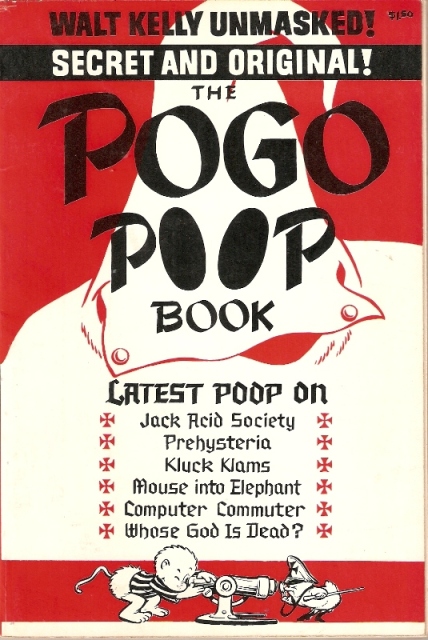
The POGO Poop Book
I picked up this book The POGO Poop Book back in March and forgot to write about it! Sorry! I guess I'm getting more forgetful in my old age, haha!This book is one of the more odd editions in the POGO catalog in that it is NOT made up of reprints of the comic strip. This is odd in and of itself, but not unheard of (The POGO Stepmother Goose is also all-original material, for example.) What really makes this book different is that it is the most overtly "political" Walt Kelly ever got. For example, the table of contents boasts the following: Late Early Poop on the Jack Acid, Kluck Klams, and Whose God is Dead? Not your typical word-play and comedy.
The Jack Acid Society is Kelly's satirical take on the white supremacist group The John Birch Society, which was making news in the early 1960s. It took me years to figure out that the name is "Jack-Asses" as a adjective!
The story "The Kluck Klams" features the disturbing story of a little Ku Klux Klan child scaring the animals of the swamp as he runs around in a sheet looking for his father. It's very disconcerting to see Pogo befriending this child and helping him find his father. The moral is, of course, that hatred equals darkness and evil. Significantly, we never see what kind of character it is under the sheet. The message, obviously, is that it could be anyone.
The final portion of the book features theologian Chicken Little making aspirations to two bed bugs about how many angels can stand on the head of a pin. (His answer is 2,619 1/2.) They don't believe him. So he shouts, "If this word is not right, may my God fall from His heaven!" And then, of course, an acorn falls on his head! So instead of running around saying "The sky is falling!" he shouts, "God is dead!"
Pretty serious stuff for funny animal comic strip characters.
Artistically, Walt Kelly is at the top of his game. I've seen POGO characters from their initial appearance in 1948 to their last year of publication in 1973 and my favorites are definitely the later 60's versions of the characters. They seem more open, flowing, and "friendly" during this period then they did earlier and then later, before Mr. Kelly's health deteriorated and they became more brushy and ill-defined.
This is a great book and a wonderful addition to my POGO collection. I am SO glad I went with my wife to the antique mall and found it!
Thursday, October 25, 2012
We Go POGO by Kerry D. Soper
Any one who reads this blog on any type of regular basis knows that I LOVE
"POGO" by Walt Kelly. Hell, I just wrote a commemorative article about
Walt Kelly on the anniversary of his death last week! It should not come
as any surprise that I go to places like ebay and amazon and type in
"POGO" just to see if there is anything new (or newly available).
Which is how I found the topic of today's article, WE GO POGO by Kerry D. Soper. Professor Soper is an associate professor of humanities, classics, and comparative literature at Bringham Young University. He is the author of Garry Trudeau: Doonesbury and the Aesthetics of Satire.
While I'm quoting the back of the book jacket, how about this for a write-up?
Walt Kelly (1913-1973) is one of the most respected and innovative American cartoonists of the 20th Century. His long-running POGO newspaper strip has been cited by modern comics artists and scholars as one of the best ever.....WE GO POGO is the first comprehensive study of Kelly's cartoon art and his larger career in the comics business. Author Soper examines all aspects of Kelly's career...from his high school drawings; his work on such animated Disney movies as DUMBO...; and his 1930s editorial cartoons for LIFE....Soper taps Kelly's extensive personal and professional correspondence and interviews with family members, friends, and cartoonists to create a complex portrait of one of the art form's true geniuses.
Which is all well and good, except....it aint' true! In the immortal words of Albert the Alligator: Rowrbazzle! This is a tedious, badly-written book about a subject that should have been...well...ANIMATED, for crying out loud! I tried....really I tried...to read this book. I got as far as the second chapter, Comedy and Satire in POGO, page 98, before I had to give up. (The book is 218 pages of TINY print 42 lines per page and sparsely I say *sparsely* illustrated!!) (To which Churchy would say, "I's prefers rutabeggas to sparsely in my salads," and Owl would say, "What's that you say? Who's a beggar? Homeless, here in the swamp!? We need a program, I tell you! Stamp out homelessness!")
If you are possibly thinking I am exaggermatating the extent of the boringness of this boring book, I quote again, verbatim verbiage from the vernal villain:
In addition to behaving like a Shakespearean fool in this respect, Pogo also takes on the pedigree of a satiric minstrel or griot. The truth-telling minstrel figure has deep roots in the European tradition; like the jester or fool, the minstrel in some cases had special license to criticize authority figures or parody the official voice and texts of the culture. West African culture had its own version of this privileged social critic, the griot, the feared but protected community jester who "combined the talents of the musician with those of the innovative poet (weaving "his own comments, moral judgments and isolated poetic images into his songs") and the clever trickster-jester to accomplish his ends." (Watkins 64) (page 84, University Press of Mississippi edition)
To this I say:
Deck us all with Boston Charlie, Walla Walla Washington and Kalamazoo!
If you like POGO and/or are a fan of Walt Kelly, DON'T buy this book. It's by some professor who is trying to use half-dollar words when the five and dime variety would suffice just as well. The jacket says it's about Kelly, but I read the Introduction and The Short Biography and there were very few quotes. Just a lot of talk by Professor Soper. You don't need a lot of words to understand and appreciate POGO. Here, let me show you:
I repeat, don't buy this book. Borrow it from you local library if you think you'd like to validate my opinion. But if you're going to buy something about/by Walt Kelly, buy THIS instead!!
Addendum 12-21-12
I got the following comment from Professor Soper himself, and it made me feel a *tad* harsh in my criticism. I'm not going to back-pedal in my criticism of some of his word choices ("griot"? really!?!?) but perhaps I should have been more clear in my main criticism: it ain't the book I thought it was going to be. And that is my problem, not Professor Soper.
Honestly, I have been thinking I need to buy this book just because I want to have it in my collection.
So.....go to your library and borrow it. Read it. Then send Professor Soper a comment asking him to write more lively the next time he writes about something so inherently fun.
Which is how I found the topic of today's article, WE GO POGO by Kerry D. Soper. Professor Soper is an associate professor of humanities, classics, and comparative literature at Bringham Young University. He is the author of Garry Trudeau: Doonesbury and the Aesthetics of Satire.
While I'm quoting the back of the book jacket, how about this for a write-up?
Walt Kelly (1913-1973) is one of the most respected and innovative American cartoonists of the 20th Century. His long-running POGO newspaper strip has been cited by modern comics artists and scholars as one of the best ever.....WE GO POGO is the first comprehensive study of Kelly's cartoon art and his larger career in the comics business. Author Soper examines all aspects of Kelly's career...from his high school drawings; his work on such animated Disney movies as DUMBO...; and his 1930s editorial cartoons for LIFE....Soper taps Kelly's extensive personal and professional correspondence and interviews with family members, friends, and cartoonists to create a complex portrait of one of the art form's true geniuses.
Which is all well and good, except....it aint' true! In the immortal words of Albert the Alligator: Rowrbazzle! This is a tedious, badly-written book about a subject that should have been...well...ANIMATED, for crying out loud! I tried....really I tried...to read this book. I got as far as the second chapter, Comedy and Satire in POGO, page 98, before I had to give up. (The book is 218 pages of TINY print 42 lines per page and sparsely I say *sparsely* illustrated!!) (To which Churchy would say, "I's prefers rutabeggas to sparsely in my salads," and Owl would say, "What's that you say? Who's a beggar? Homeless, here in the swamp!? We need a program, I tell you! Stamp out homelessness!")
If you are possibly thinking I am exaggermatating the extent of the boringness of this boring book, I quote again, verbatim verbiage from the vernal villain:
In addition to behaving like a Shakespearean fool in this respect, Pogo also takes on the pedigree of a satiric minstrel or griot. The truth-telling minstrel figure has deep roots in the European tradition; like the jester or fool, the minstrel in some cases had special license to criticize authority figures or parody the official voice and texts of the culture. West African culture had its own version of this privileged social critic, the griot, the feared but protected community jester who "combined the talents of the musician with those of the innovative poet (weaving "his own comments, moral judgments and isolated poetic images into his songs") and the clever trickster-jester to accomplish his ends." (Watkins 64) (page 84, University Press of Mississippi edition)
To this I say:
Deck us all with Boston Charlie, Walla Walla Washington and Kalamazoo!
If you like POGO and/or are a fan of Walt Kelly, DON'T buy this book. It's by some professor who is trying to use half-dollar words when the five and dime variety would suffice just as well. The jacket says it's about Kelly, but I read the Introduction and The Short Biography and there were very few quotes. Just a lot of talk by Professor Soper. You don't need a lot of words to understand and appreciate POGO. Here, let me show you:
THIS is what POGO was all about (click to en-biggen). 

I repeat, don't buy this book. Borrow it from you local library if you think you'd like to validate my opinion. But if you're going to buy something about/by Walt Kelly, buy THIS instead!!
Addendum 12-21-12
I got the following comment from Professor Soper himself, and it made me feel a *tad* harsh in my criticism. I'm not going to back-pedal in my criticism of some of his word choices ("griot"? really!?!?) but perhaps I should have been more clear in my main criticism: it ain't the book I thought it was going to be. And that is my problem, not Professor Soper.
Honestly, I have been thinking I need to buy this book just because I want to have it in my collection.
So.....go to your library and borrow it. Read it. Then send Professor Soper a comment asking him to write more lively the next time he writes about something so inherently fun.
Thursday, October 18, 2012
RIP Walt Kelly (1913~1973)
Today, October 18 is the 39th anniversary of the death of comic-strip great Walt Kelly. He died on October 18, 1973 after a long illness.
He was, of course, the creator of the world-famous comic strip POGO. I can remember picking out *that* strip to read on the "funnies' pages" of the St. Louis Post-Dispatch as a kid. When it went away, the world got a little bit colder.
Rest in Peace, Mr. Kelly
You'll never be forgotten as long as I have something to say about it.
Subscribe to:
Comments (Atom)